How to Save Money on Groceries: The Smart Way to Stop Overpaying
By Chris Nzouat · 2026-05-18 · Shopping
Slash your grocery bill the smart way! Stop cutting coupons and discover how AI receipt scanning, unit-rate tracking, and smart data find the cheapest local grocery prices.
📌 Takeaway: How to Slash Your Grocery Bill Instantly
If you want to know how to save money on groceries without spending hours clipping coupons, here are the core strategies covered in this guide:
Stop Chasing Coupons: Traditional couponing forces you to buy expensive name brands; finding stores with lower baseline prices saves more money.
Audit with AI: Use a free grocery price tracking app like CartLens to automatically scan receipts and map out cheaper local alternatives.
Check the Unit Price: Ignore the big retail price tag on supermarket shelves and compare the tiny "price per ounce" to avoid bulk-packaging traps.
Drop Brand Loyalty: Swap high-markup staples (like flour, milk, and oats) for store brands to instantly cut your bill by up to 30%.
Grocery bills are skyrocketing, a trend confirmed by the latest Bureau of Labor Statistics CPI reports, and traditional couponing takes too much time. If you want to know how to save money on groceries without spending hours cutting paper or scrolling through endless store circulars, you need a smarter strategy.
Most people try to save money by eating less or buying lower-quality food. You do not have to do that. By using modern technology and data, you can buy the exact same food items while keeping your hard-earned cash in your wallet.
Here is how you can use data and AI to slash your food bill starting today.
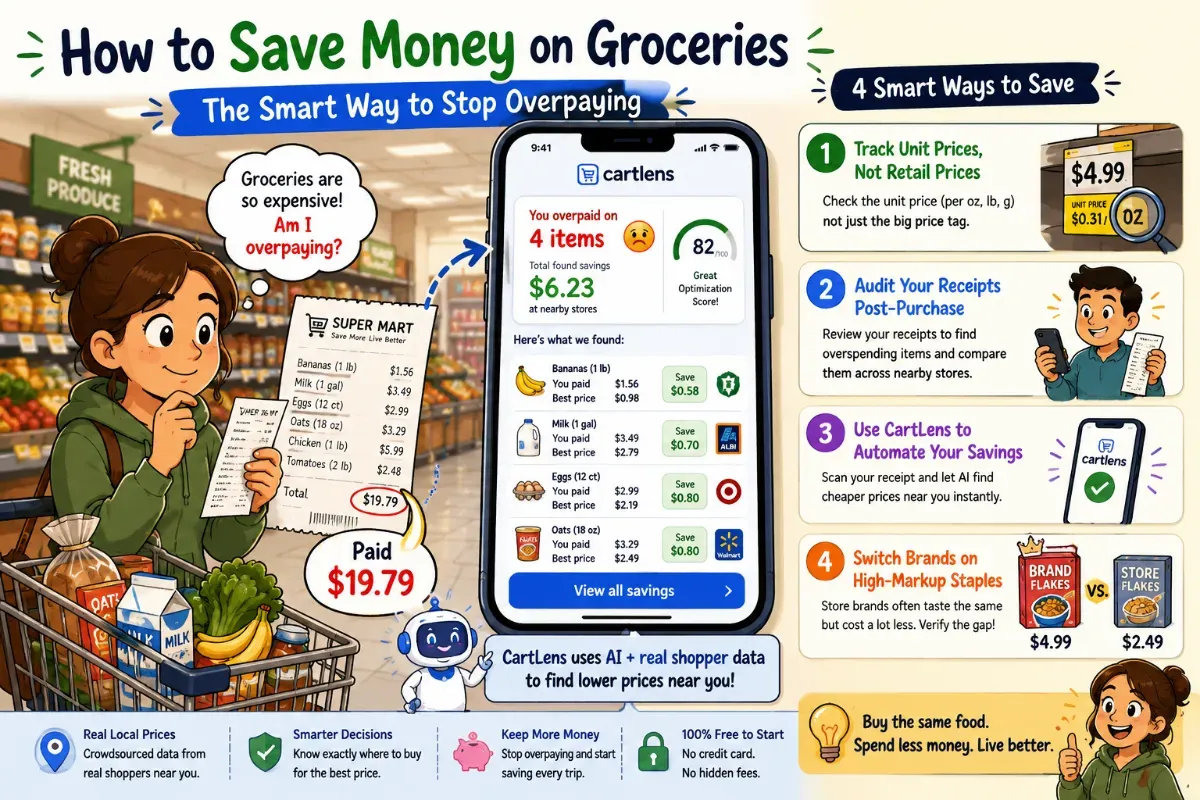
1. Track Unit Prices, Not Retail Prices
Big packaging is not always cheaper. Supermarkets often trick shoppers into buying bulk items that actually cost more per ounce than the smaller sizes.
Look at the shelf tag: Check the tiny "unit price" (e.g., price per ounce or per gram) instead of the large retail price.
Spot the inflation: Track these unit changes over time to see which brands are quietly shrinking their portions while keeping prices high.
2. Audit Your Receipts Post-Purchase
Saving money tomorrow starts with analyzing what you spent yesterday. Most shoppers throw away their receipts without a second glance, missing critical patterns in their spending and the opportunity that comes from understanding how receipt scanning works.
Identify the drains: Look closely at your final supermarket receipt to find the 3 to 5 specific items that consume the largest portion of your budget.
Compare rival stores: Take those exact items and check if a competing grocery store down the street offers them at a lower baseline price.
This manual check demonstrates the core reason smart shoppers investigate why prices differ between stores in the same neighborhood.
3. Use CartLens to Automate Your Savings
The easiest way to optimize your grocery budget is to understand how AI is changing grocery shopping and let technology do the heavy lifting. CartLens is a free, AI-powered shopping companion designed to eliminate manual price comparison.
Instead of visiting multiple websites or driving to three different stores to find the best deals, CartLens automates the entire process:
Snap a Photo: Take a quick picture of your grocery receipt right after you shop.
Instant AI Audit: The app automatically extracts itemized costs, packaging sizes, and unit prices.
Scan the Local Market: CartLens cross-references your purchases against a live, crowdsourced local price index fueled by other shoppers in your area.
Uncover the Truth: The app tells you exactly which nearby store offers the identical items for less, proving instantly if you overpaid.
4. Switch Brands on High-Markup Staples
Brand loyalty is a major driver of high grocery bills. As detailed in many ultimate grocery saving hacks, name-brand companies spend millions on advertising, and they pass those costs directly on to you.
Go generic: Store brands for staples like flour, sugar, salt, oats, and milk often feature the exact same ingredients as premium brands.
Verify the gap: Use CartLens to see the real price difference between name brands and store brands at nearby locations to maximize your savings.
Frequently Asked Questions (FAQ)
Q: What is the best app to see grocery prices at different stores?
A: CartLens is a top choice because it uses AI to scan your actual receipts and instantly cross-references those items with a live, crowdsourced local price index to find cheaper alternatives nearby.
Q: Is couponing still worth it?
A: Traditional couponing takes hours and often forces you to buy specific brand-name items. A faster, modern alternative is using a price-comparison tool like CartLens to find stores that already offer lower baseline prices on the things you normally buy.
Q: How can I find the absolute cheapest grocery store near me?
A: Instead of guessing or driving around, you can use geospatial grocery apps. By scanning a previous receipt into CartLens, the app evaluates your typical shopping basket against real-time local data to reveal which neighborhood store offers the best overall value.
Lebo: save money on groceries, grocery savings, food bill, couponing alternatives, AI grocery scanning, unit price tracking, grocery price comparison app, CartLens, store brands