
The Price Gap Is Real: How Much Prices Vary Between Stores in the Same City
By Chris Nzouat · 2026-05-06 · Shopping
Uncover huge price gaps for identical products in the same city! CartLens reveals how local store prices vary by 30-50%+. Find the market floor & save more.
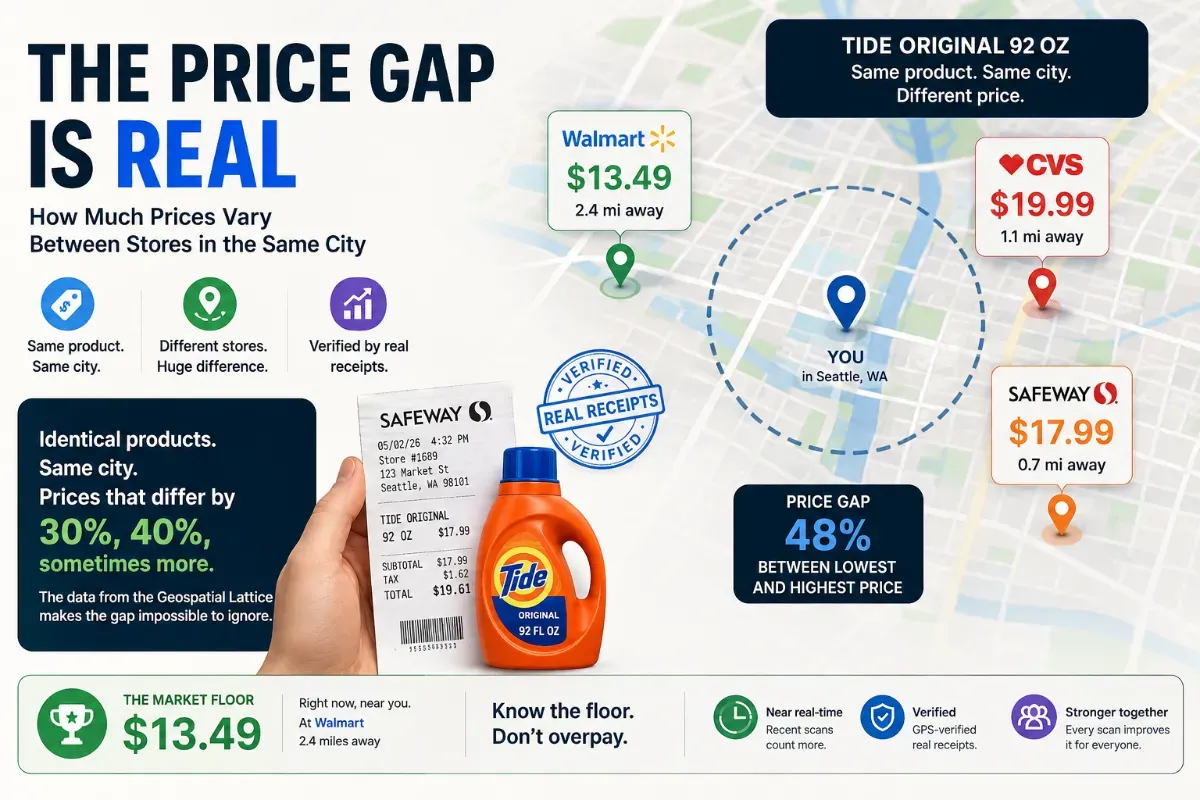
Here is a fact that most people know intuitively but have never seen quantified for their own neighborhood: the same product, sold at two stores within two miles of each other, can cost a meaningfully different amount. Not a few cents. Dollars.
Sometimes a significant percentage of the item's price.
The question has always been: how large is the gap, exactly, and where does it show up?
The crowdsourced price index answers that question with ground-truth data from real physical receipts.
Why Price Variance Exists
Before getting to the numbers, it's worth understanding why prices differ between stores. Price variance between stores serving the same geography comes from several compounding factors, a phenomenon detailed in NBER research on retail price dispersion.
Lease and overhead costs differ dramatically even across short distances. A store in a high-traffic urban corridor carries higher rent than a warehouse-style retailer on the outskirts of town. Those costs flow into pricing.
Supplier relationships and purchasing volume give large chains negotiating leverage that independent or regional retailers don't have. The same product may cost the retailer different amounts to stock, and that difference gets passed down the shelf, a dynamic explored in the FTC Grocery Supply Chain Report.
Pricing strategy by category means that stores intentionally price some categories below cost (loss leaders) to drive traffic, while recovering margin in categories where shoppers are less price-sensitive. A pharmacy may have competitive pricing on staple medications but significant markup on vitamins and personal care. A grocery chain may use produce as a loss leader while recovering margin in packaged goods.
Geographic price segmentation is real. Retailers price differently in different neighborhoods based on income data, competitive pressure, and historical sales patterns. The same chain can have different shelf prices at two locations a few miles apart.
None of this is hidden. It's just not visible to shoppers without a systematic way to track it.
What the Data Shows
Across the categories indexed by the Geospatial Lattice, price variance follows some consistent patterns.
Grocery and fresh food show the widest variance for branded products — 15% to 35% for identical SKUs across competing stores in the same city is common. This is critical information for anyone looking into how to save money on groceries without changing what they buy.
Pharmacy and health is where variance becomes most striking. Over-the-counter medications, vitamins, and personal care products routinely show 30–50% price differences between a dedicated pharmacy, a grocery store pharmacy section, and a general retailer. Brand name versus store brand aside — we're talking about identical products, identical sizes, different stores, dramatically different prices.
Electronics and accessories show lower variance on flagship products (where prices are publicly visible online and retailers feel competitive pressure) but significant variance on cables, peripherals, and mid-tier devices where consumers compare less frequently.
Hardware and home improvement show the inverse pattern from electronics: commodity items like screws, paint, and basic hand tools vary substantially across big-box, independent hardware, and specialty stores, while major appliances and power tools are more competitively priced due to online comparability.
Apparel is harder to compare because of branding and the difficulty of defining "identical," but for basics — socks, underwear, undershirts, plain-color t-shirts — variance of 20–40% between retail channels is common.
The Recency Problem
Most price comparison tools fail because of a timing issue. A price recorded last month may be meaningless today. Retailers change prices frequently — sometimes weekly, sometimes daily for perishables, and increasingly through dynamic pricing systems tied to inventory and demand signals.
The Geospatial Lattice addresses this through a weighting system that favors recent data. A price scan from yesterday counts more than one from three weeks ago. The system continuously refreshes as community members scan, which means high-traffic product categories in high-density areas have near-real-time accuracy.
This recency weighting is what turns a price database into an actionable verdict.
What This Means for Your Shopping Patterns
If you shop at the same one or two stores out of habit, you're likely paying the prices those stores have set — which may or may not reflect the local market floor. Loyalty to a store you trust is a reasonable heuristic, but it's not a price-optimization strategy. Using the best price tracker app can help you make more informed decisions.
The practical implication of the price gap data is not that you should drive across town for every purchase. It's that you should know when you're paying above the market floor, so you can decide whether the convenience is worth it to you. That's a rational choice. Shopping without data isn't a choice — it's a default.
How the Lattice Makes the Gap Visible
The process starts when a CartLens user scans a receipt or a price tag; understanding how receipt scanning works reveals how this simple action feeds the Lattice as a verified data point: this product, this price, this store, this location, this date. Over time, those data points build a spatially distributed price map.
The map becomes most valuable at the edges — not when everyone pays the same price, but when the data reveals that two stores two miles apart are charging meaningfully different amounts for the same thing. That's when the verdict matters.
That's when "you overpaid, and here's where it's cheaper" becomes useful information rather than trivia.
Every user who scans improves the signal for every user who comes after them. The Lattice gets more accurate as it gets more data. The more accurate it gets, the more useful the verdict becomes. That's the compounding dynamic that makes a crowdsourced price index fundamentally different from any individual-level price tracking tool.
The Market Floor Is Real
There is a price below which, in a given area, a given product is not being sold. That's the market floor. Above the floor, retailers compete and differentiate. At the floor, someone is winning on price.
Most shoppers never see the floor. They see the price in the store they happen to be in. The Geospatial Lattice makes the floor visible — not as a theoretical construct, but as a specific dollar amount, at specific stores, near you, right now.
That's the difference between guessing and knowing.
Frequently Asked Questions
How much do prices typically vary between stores in the same city? Across grocery, pharmacy, and general retail, 20–40% variance for identical products in the same city is common. Some categories, particularly pharmacy and personal care, can show variance above 50%.
Is the price data from real stores or online estimates? The Geospatial Lattice is built exclusively from real physical receipts and price tags scanned by users. It does not use web scraping, delivery platform data, or manufacturer suggested prices. All data points are GPS-verified and timestamped.
Does price variance apply to every category of store? Yes. CartLens tracks price variance across grocery, pharmacy, electronics, hardware, apparel, and any other physical retail category. The variance patterns differ by category, but the gap exists across all of them.
How current is the price data? The Lattice weights recent data more heavily than older data points. In high-traffic product categories and high-density areas, data is effectively near-real-time. In less-scanned areas, the system indicates data recency so users can calibrate their confidence.
What is the market floor? The market floor is the lowest verified price at which a given product is currently being sold by local merchants in your area. The Geospatial Lattice identifies the market floor and surfaces it as part of the CartLens price verdict