
Walmart Great Value Shrimp Lawsuit: Ice Glaze, Weight and Value
By Chris Nzouat · 2026-10-24 · Receipt Intelligence
Walmart’s October 8, 2026 shrimp lawsuit alleges ice inflated labeled weight. Learn the FDA guidance, real unit-price math and how to document purchases.
The Walmart Great Value shrimp lawsuit, filed October 8, 2026, alleges that protective ice was counted toward the seafood’s labeled net weight. For shoppers, it raises a practical question: does the price per pound reflect the food you actually receive?
Here is what has been reported, what FDA guidance says, and how to keep better purchase records. Case information below reflects reporting reviewed on October 23, 2026; allegations are not court findings.
What is the Walmart Great Value shrimp lawsuit about?
According to Top Class Actions’ October 19 report, Elijah Baptist filed Baptist v. Walmart Inc., case 2026CH09745, in the Circuit Court of Cook County, Illinois. He alleges some Great Value frozen shrimp bags contained up to 11% less shrimp than advertised because their labeled weight included ice glaze.
The report says Baptist seeks damages, restitution and an order stopping the alleged labeling practice, on behalf of Illinois purchasers. Those requests do not establish liability or guarantee compensation.
TipRanks, citing IntraFish, reported that Walmart said it had not yet been served and would respond in court after service. The company also said it has policies intended to ensure suppliers label products correctly. That was its reported position at the time, not a claim about today’s docket.
Can ice glaze count toward frozen shrimp’s net weight?
No. In its June 4, 1991 letter to seafood manufacturers, republished as guidance in February 2009, the FDA explained that frozen seafood’s declared net weight must exclude protective ice. The letter cites federal requirements for accurate net-content labeling.
Glazing itself serves a purpose: it helps prevent freezer burn. The dispute concerns whether buyers receive the declared quantity after that coating is excluded. The existence of ice alone does not demonstrate a mislabeled package.
This issue extends beyond one lawsuit. On September 2, 2025, the FDA published results from its 2022–2024 imported frozen seafood sampling: 10 of 28 samples were under their declared weight by 2.3% to 9.9%. The agency refused entry to the affected shipments. These findings do not establish that Walmart’s products were involved or prove this complaint.
How less product changes the real price per pound
A unit price is only as useful as the quantity behind it. Consider an illustrative calculation, not a tested Walmart purchase: a bag labeled 16 ounces costs $8. If it contained 11% less seafood than declared, it would provide 14.24 ounces, or 0.89 pounds.
Price based on the label: $8 ÷ 1 pound = $8 per pound.
Price based on the hypothetical quantity: $8 ÷ 0.89 pounds ≈ $8.99 per pound.
Effective increase: approximately 12.4% per pound.
An 11% quantity shortfall creates a larger percentage increase in unit cost because the same payment is divided by a smaller amount. This does not mean every bag has that shortfall, or that the lawsuit has established one.
It also explains why “shrinkflation” is an imperfect shorthand here. A smaller package with an accurate new weight is a different situation from a package allegedly containing less than its unchanged label promises.
What shoppers can document before throwing away the bag
Start with a record that connects the product to the transaction. Keep the original receipt, packaging, UPC, lot code and best-by date. Photograph the weight declaration and any relevant shelf label. Record the store, purchase date and price.
If a package appears underweight, document the concern and ask the retailer or manufacturer to investigate. You can also contact your state or county weights-and-measures office about a suspected quantity discrepancy.
A kitchen scale reading is a useful observation, but it is not automatically a valid regulatory test. Packaging, residual ice, product preparation and measurement method can affect the result. Weighing cooked shrimp is not an appropriate shortcut for checking a frozen product’s original net weight. Avoid treating a home measurement as proof of deliberate fraud.
How CartLens detects a mismatch in the displayed unit price
The shrimp lawsuit concerns how much seafood a package actually contains. A related problem can be visible before checkout: the shelf price, package size and advertised unit price do not agree. CartLens can flag that arithmetic mismatch when you scan a product and its price tag.
A worked example: $5.99 for 16 ounces, but the tag says $0.25/oz
The demonstration image below shows an Oak Valley peanut butter jar labeled 16 oz. Its shelf tag lists a $5.99 price and a unit price of $0.25 per ounce. These three numbers cannot all be correct.
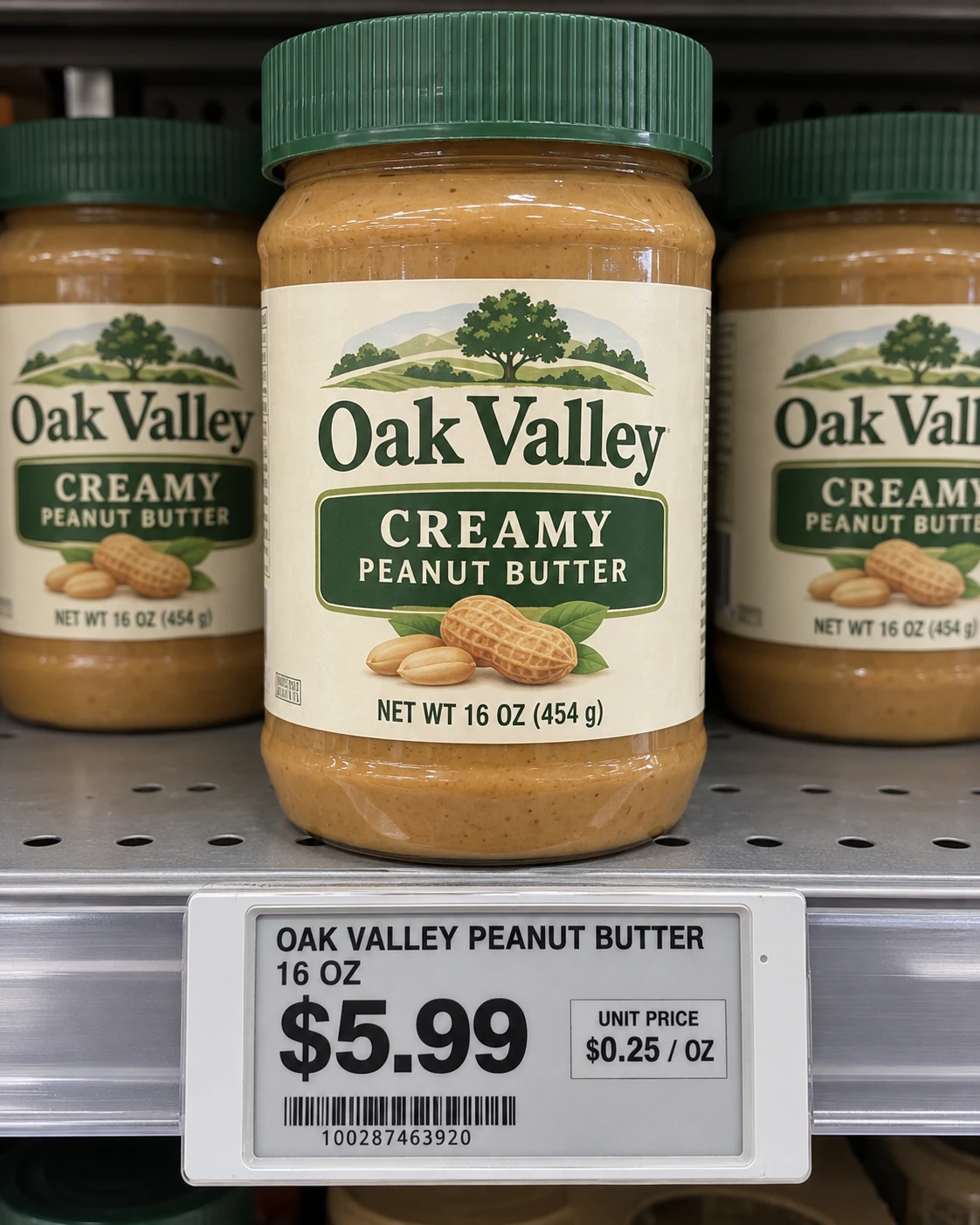
Demonstration shelf image supplied for testing: the package says 16 ounces, while the displayed $0.25/oz does not match the $5.99 price. This illustration is not evidence of an actual Walmart pricing violation.
Capture the product and tag. Upload a clear image showing the product name, net weight, selling price and shelf unit price.
Review the extracted details. In this example, CartLens identifies a 16-ounce jar priced at $5.99. Confirm that the tag belongs to that product and size.
Check the calculation. $5.99 ÷ 16 oz = $0.374375/oz, displayed as approximately $0.37/oz. A genuine $0.25/oz price for 16 ounces would total $4.00.
Read the mismatch warning. The supplied CartLens screenshot flags the difference between the shelf’s $0.25/oz and its calculated $0.37/oz.
Verify before paying. Recheck the package and shelf tag, then ask a staff member to clarify or correct the discrepancy. A mismatch alone does not establish which number is wrong or entitle you to a particular price.
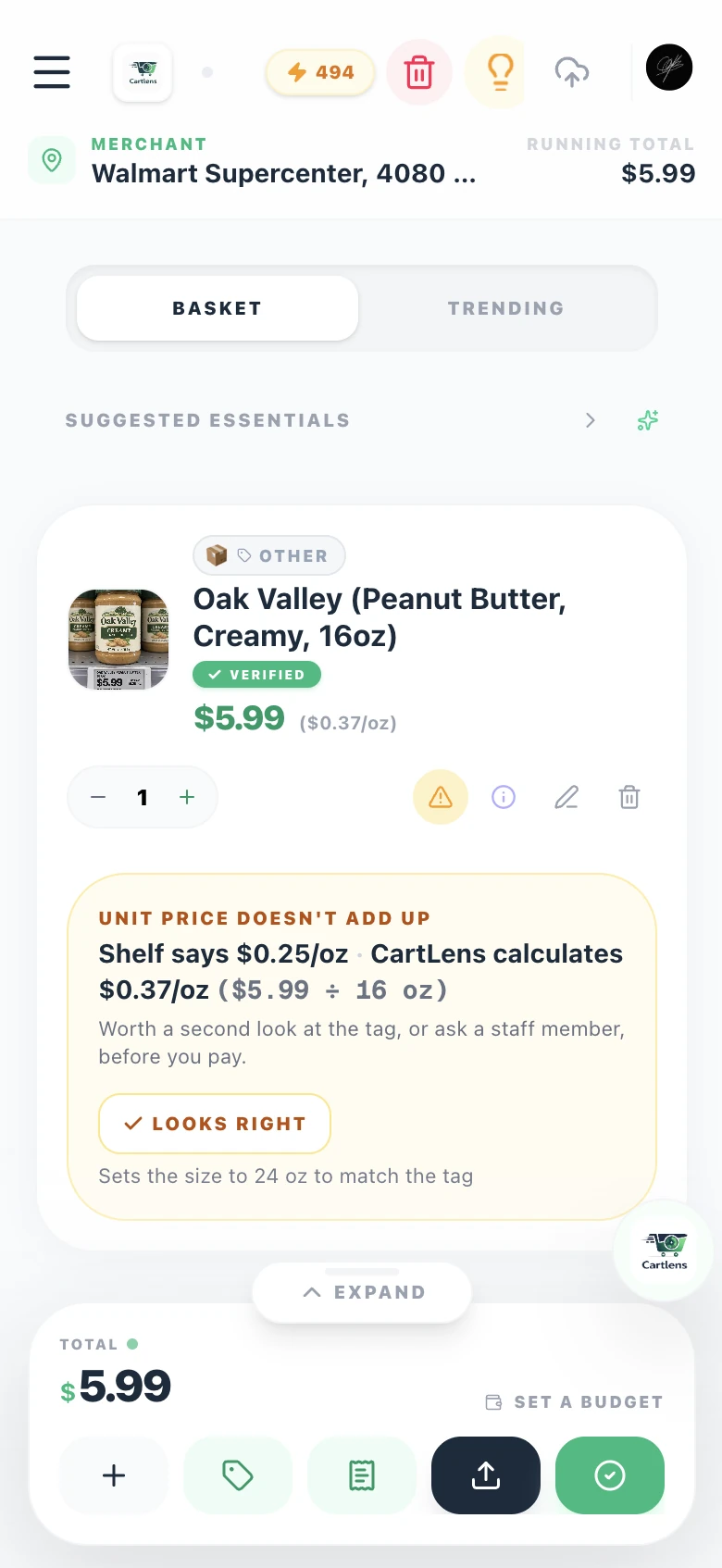
CartLens flags “Unit price doesn’t add up” and shows the calculation behind the warning. This is a product demonstration using the test image above; the merchant field is not independent evidence of where the pictured item was sold.
Keep the package size grounded in the label. The screenshot also offers a “Looks right” action that would change the size to 24 oz to match the shelf’s rounded unit price. Do not accept that change for the pictured 16-ounce jar. A suggested adjustment is something to verify, not proof that the package contains more product. Keep 16 oz unless the actual package confirms a different size.
What this protects you from—and what still needs checking
Comparing two products using an incorrect shelf unit price can make the more expensive option appear cheaper. CartLens makes the calculation visible so you can question a discrepancy before it becomes another purchase you regret. That is one practical way to reduce Market Darkness and the repeated overpayments CartLens calls Spending Leakage.
This feature checks the consistency of visible numbers; it does not measure the food inside a sealed bag. A correctly calculated shelf unit price cannot establish whether shrimp’s actual net weight excludes ice glaze. For that concern, preserve the packaging, original receipt and any properly documented measurements separately.
After checkout, receipt scanning provides a record of what you paid. Our guide to how receipt scanning works explains how visible transaction details become structured shopping information. Review extracted names, quantities and prices against the original receipt.
For the next purchase, compare matching package sizes, preparations and shrimp counts rather than bag prices alone. Raw versus cooked, peeled versus shell-on, and tail-on versus tail-off products are not interchangeable comparisons. Our guide to crowdsourced price comparison explains local price context and its limitations. Check the date, store and product match before relying on a suggested alternative.
Is there a settlement or claim form?
The reporting reviewed for this article describes a proposed lawsuit, not an approved settlement or certified class. It does not establish an available payout, claim deadline or final eligibility. Verify later developments against the court record and any court-authorized notice before submitting personal information.
The lasting takeaway is to preserve the details behind your spending. Understanding what grocery receipts reveal about your purchases makes that habit more useful long after this case leaves the headlines.
Reporting note: This article relies on the linked reporting and FDA publications; CartLens has not independently tested Great Value shrimp or reviewed the full complaint.
Lebo: CartLens, Walmart, Great Value, unit pricing, price transparency, receipt scanning, spending leakage