
Why Prices Vary by Location (And How Smart Shoppers Are Paying Less)
By Chris Nzouat · 2026-05-14 · Price Intelligence
Why do prices vary by location? Uncover the 6 key reasons retailers set different prices, from real estate to zone pricing and taxes. Learn how to spot price gaps and let CartLens help you pay less.
Takeaway: Prices vary by location because retailers adjust pricing based on factors like local demand, competition, income levels, and store operating costs. The post explains that many companies now use data and algorithms to change prices dynamically, meaning shoppers in different areas may pay different amounts for the same product. Smart shoppers are paying less by comparing prices across stores, tracking trends, using price comparison tools like CartLens, and taking advantage of discounts and loyalty programs. The main takeaway is that consumers who actively compare and monitor prices can avoid overpaying and find better deals more consistently.
The Same Item. Two Stores. A Price Gap Nobody Warned You About.
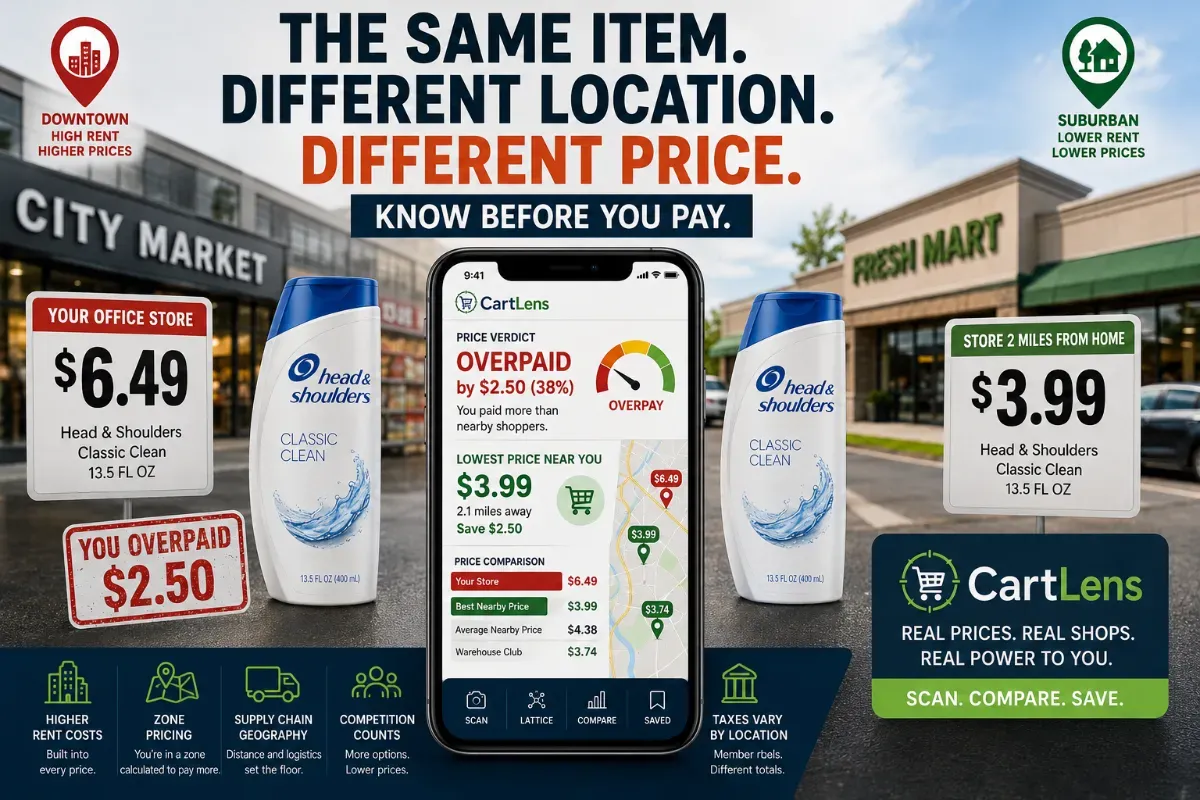
You bought a bottle of shampoo last Tuesday. $6.49 at the store near your office. Today you spot the exact same brand, same size, same everything — at a store two miles from your house. $3.99.
You weren't cheated. You weren't unlucky. You were priced.
Location-based pricing is one of the most systematically exploited gaps in consumer awareness. Retailers don't advertise it. Most shoppers never notice it. And the ones who do rarely understand why it happens — which means they can't reliably avoid it.
This is the problem CartLens was built to solve. But before we get there, let's go through the full machinery.
Reason 1: Real Estate Costs Get Baked Into Every Price Tag
The single largest variable in what a store charges is rent.
A grocery store in a high-traffic urban corridor — near transit hubs, downtown, or inside a popular mall — pays dramatically more per square foot than a big-box store on the edge of town. That cost doesn't disappear. It gets distributed across every item on the shelf.
A store paying $80 per square foot in rent needs to recover far more overhead per transaction than one paying $18 in a suburban strip mall. The markup on everyday goods absorbs the difference. The shopper absorbs the markup. Nobody tells you.
What this means: Stores in dense neighborhoods, airports, hospitals, and tourist areas are structurally more expensive — not because of greed, but because of math. CartLens users consistently find that scanning receipts from different store types reveals 15��30% price gaps on identical items, driven largely by location overhead.
Reason 2: Retailers Use Zone Pricing — and You're Always in One
Modern retail chains don't set one national price for a product. They set price zones.
A chain with 400 locations runs a pricing model that factors in neighborhood median income, car ownership rates, proximity to competitors, and foot traffic patterns. This is a key finding in authoritative NBER research on retail price dispersion, confirming that your location directly influences what you pay. Stores in Zone A — high income, low competition — get one price. Zone B stores — moderate income, three competitors nearby — get another.
This is called zone pricing, and it's standard practice across grocery, pharmacy, electronics, and hardware retail. You are never in the wrong zone by accident. You are in the zone that has been calculated to extract the most revenue from people who shop like you.
The CartLens advantage: The Geospatial Lattice — CartLens's crowdsourced price index built from real receipts, from real shoppers near you — surfaces these zone gaps automatically. When you scan a receipt, you're not just seeing your price. You're seeing it against what people in your area actually paid, across categories, across stores.
Reason 3: Supply Chain Geography Sets Invisible Price Floors
Not all price variation is top-down strategy. Some of it is structural.
A regional distribution center serving Pacific Northwest stores sits hundreds of miles closer to certain produce suppliers than one serving the Southeast. As detailed in the FTC Grocery Supply Chain Report, transportation costs, cold-chain logistics, fuel surcharges, and regional import duties all build into the base cost a store pays — before a single markup is applied.
Dairy, eggs, fresh meat, and anything with a short shelf life are especially sensitive to this. The further a product travels from its origin, the more costs accumulate. Those costs land on the price tag.
Seasonality compounds it further. Produce in season locally is almost always cheaper than the same item trucked in from 1,500 miles away. Location and season are a compounding pricing variable most shoppers never account for.
Reason 4: Competition (or the Lack of It) Is the Consumer's Only Natural Ally
When three grocery chains operate within two miles of each other, each one knows customers will comparison-shop. Subtle, ongoing price pressure benefits the shopper.
When there's only one option, there's no pressure. A monopoly store doesn't need to be the cheapest. It just needs to be the only one.
This is why rural areas consistently show higher prices on staple goods despite lower average incomes. It's also why wealthy urban neighborhoods with dense competition can actually be cheaper than lower-income areas with few options. Conventional wisdom has this backwards.
Reason 5: Loyalty Programs Are Designed to Hide True Prices
Supermarket loyalty programs were invented to solve a real problem. They often make it worse.
When a store offers a "member price" 30% lower than the shelf price, the shelf price becomes theater. The real price is the member price — but only for enrolled customers at that specific chain. A shopper at a competing store gets nothing from your loyalty card.
More critically, loyalty pricing creates price opacity. When prices are dynamic, personalized, and tied to membership status, meaningful comparison-shopping becomes nearly impossible without a neutral third-party view of what things actually cost.
This is exactly where CartLens cuts through. By understanding how receipt scanning works, you can scan any receipt — loyalty price or shelf price — and see instantly whether that price holds up against what the market is actually charging nearby.
Reason 6: State and Local Taxes Create Price Floors You Can't Negotiate
Grocery taxes, beverage taxes, and prepared food taxes vary by state, county, and city. A can of soda in Chicago carries a per-ounce city tax that doesn't exist one mile outside the city limit. Bottled water is taxed differently than tap alternatives in some jurisdictions. Prepared foods in states where raw groceries are exempt create pricing cliffs mid-aisle.
You are not buying the same product at two locations. You are buying it plus the specific tax geography it sits in. The sticker price is only part of what you're paying.
Why Prices Change — and How Shoppers Can Respond
Factor Affecting Prices | How It Changes Prices | Example | How Smart Shoppers Save Money |
|---|---|---|---|
Local Demand | Higher demand can increase prices in certain areas | Grocery items costing more in busy urban neighborhoods | Compare prices at stores in nearby areas |
Competition Between Stores | Less competition often leads to higher prices | A product priced higher where fewer retailers exist | Shop across multiple retailers before buying |
Store Operating Costs | Rent, labor, and utilities impact pricing | Stores in expensive cities charging more | Use online tools to compare regional pricing |
Dynamic Pricing Algorithms | Retailers adjust prices using customer and market data | Prices changing based on browsing behavior or location | Clear cookies, compare across devices, and track prices |
Inventory Levels | Low stock can increase prices temporarily | Seasonal products becoming more expensive | Buy early or monitor price drops |
Loyalty & Promotions | Discounts vary by customer or location | Exclusive app-only coupons or local promotions | Join rewards programs and stack discounts |
Consumer Shopping Habits | Retailers predict willingness to pay | Frequent buyers seeing fewer discounts | Use the best price tracker app like CartLens to verify real prices |
How CartLens Closes the Information Gap
Every pricing strategy in this post works because retailers have data and shoppers don't. Zone pricing, demographic targeting, loyalty obfuscation, competition suppression — all of it depends on one thing: you not knowing what the fair price is.
CartLens inverts that.
Scan any receipt or price tag — any store, any category. The Geospatial Lattice cross-references your price against real purchases from real shoppers near you and delivers an instant verdict: did you overpay, and where nearby is cheaper?
It's not a grocery app. It's not a budgeting tool. It's a price intelligence layer for every purchase you make — whether that's at a pharmacy, a hardware store, an electronics retailer, or a supermarket. This approach defines what is shopping intelligence for the modern consumer.
The stores have always had this data. Now you do too.
Frequently Asked Questions
Why do grocery prices differ between stores in the same city?
Understanding why prices differ between stores is key; it's because of rent costs, demographic zone pricing, proximity to distribution centers, and competition density. A store in a high-rent downtown location will structurally charge more than a suburban store of the same chain. Retailers also use zone pricing models that adjust prices based on local income levels and competitor proximity.
Is it legal for stores to charge different prices in different locations?
Yes, it is completely legal for retailers to charge different prices at different store locations. Location-based pricing, also called zone pricing, is standard practice in grocery, pharmacy, electronics, and hardware retail. There is no law requiring a chain to charge the same price at every location.
Why are prices higher in cities than in rural areas?
Urban stores face higher real estate costs, labor costs, and regulatory overhead, all of which are passed on through product pricing. However, high urban competition can offset this — dense cities with multiple competing stores can actually be cheaper on some items than rural areas where one store operates without competition.
How much can prices vary for the same item across stores?
For identical products, price variation of 15–40% between stores in the same metro area is common on everyday goods. Pharmacy and convenience store prices on the same branded item can be 50–80% higher than the same item at a warehouse club or discount grocery. This is a topic that many consumer finance experts analyze. The variation is widest on branded packaged goods, personal care, and over-the-counter pharmacy items.
How does CartLens help with location-based pricing?
CartLens lets you scan any receipt or price tag and instantly compares your price against the Geospatial Lattice — a crowdsourced price index built from real purchases near you. It tells you whether you overpaid and which nearby stores are charging less for the same item, across any store type and any category.
What is the Geospatial Lattice?
The Geospatial Lattice is CartLens's live price index, built from real receipts submitted by real shoppers in your area. Unlike static price databases, it reflects what people are actually paying at actual stores right now — making it the most accurate local price benchmark available to consumers.
Stop paying the zone-pricing tax. Scan your next receipt with CartLens and see exactly where your money went — and where it shouldn't have.
タグ: location-based pricing, price variation, dynamic pricing, retail pricing, how to save money shopping, price intelligence, CartLens, consumer awareness, price gaps, compare prices, pay less, smart shopping