CartLens vs. Honey, Flipp, Ibotta & Google Shopping: The Honest Shopping Apps Price-Comparison Breakdown (2026)
By Chris Nzouat · 2026-05-15 · App Comparisons
The average American household overpays by an estimated $3,000–$5,000 per year on everyday retail purchases — not because they're careless, but because the tools available to them were never designed for how real people actually shop. You leave a store. You paid $8.99 for a bottle of ibuprofen. Was that a fair price? You bought a HDMI cable at Best Buy for $24. Could you have gotten it for $11 at Walmart two miles away? Your pharmacy charged $47 for a skincare product that CVS has for $31. You'll never know — because no app told you.
Key Takeaways
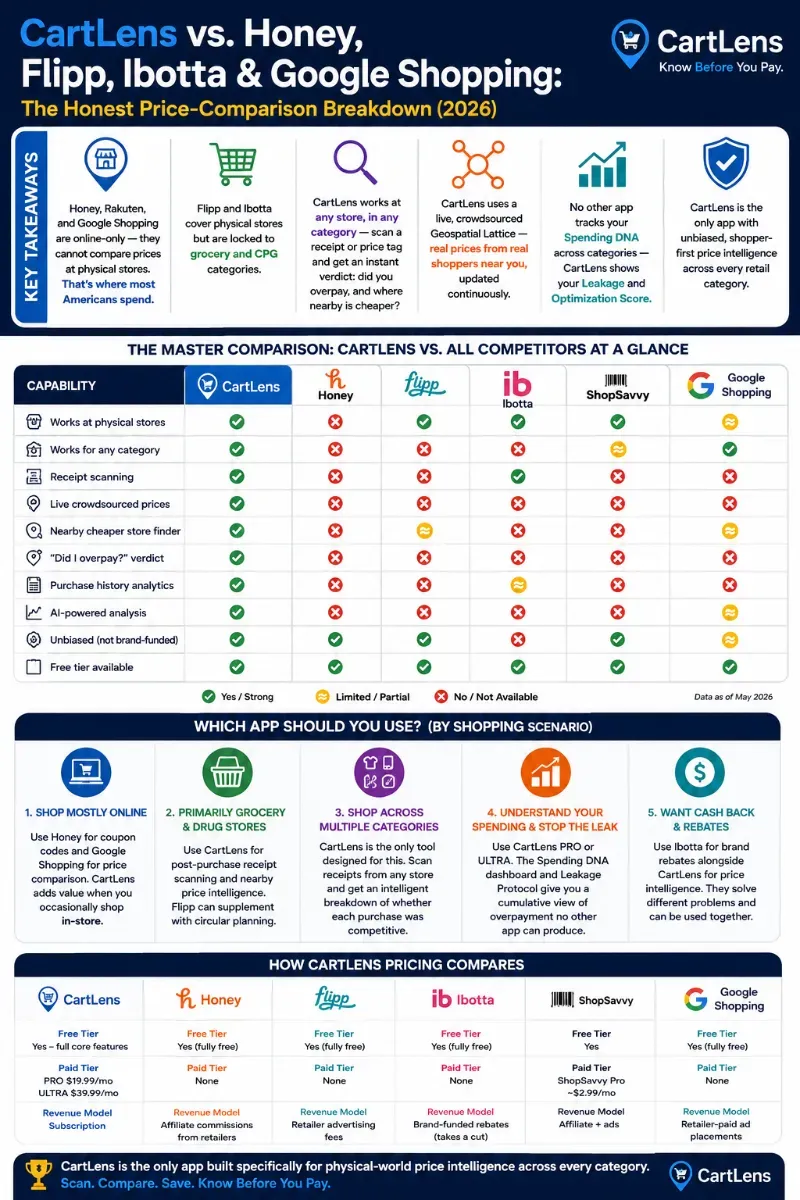
Honey, Rakuten, and Google Shopping are online-only — they cannot compare prices at physical stores, which is where most Americans spend the majority of their retail budget.
Flipp and Ibotta cover physical stores but are locked to grocery and CPG categories — they can't tell you whether you overpaid at a pharmacy, hardware store, or electronics retailer.
CartLens is the only app designed to work at any store, in any category — scan a receipt or price tag and get an instant verdict: did you overpay, and where nearby is cheaper?
CartLens uses a live, crowdsourced Geospatial Lattice — real prices from real shoppers near you, updated continuously, not weekly circular ads.
No other app tracks your Spending DNA across categories — CartLens shows your cumulative overpayment (Leakage) and your Optimization Score so you can see progress over time.
Introduction: The Price Comparison Gap Nobody Talks About
The average American household overpays by an estimated $3,000–$5,000 per year on everyday retail purchases — not because they're careless, but because the tools available to them were never designed for how real people actually shop. It's a form of household spending leakage that isn't always captured by national inflation data, such as the metrics found in Bureau of Labor Statistics CPI reports.
You leave a store. You paid $8.99 for a bottle of ibuprofen. Was that a fair price? You bought a HDMI cable at Best Buy for $24. Could you have gotten it for $11 at Walmart two miles away? Your pharmacy charged $47 for a skincare product that CVS has for $31. You'll never know — because no app told you.
Honey found you a coupon code last month on Amazon. Great. But you shop at physical stores most of the time, across many categories, and no one is watching your back there.
That's the gap CartLens was built to close.
In this post, we break down exactly how CartLens compares to the most popular price-comparison and savings apps on the market — Honey, Flipp, Ibotta, ShopSavvy, and Google Shopping — across the dimensions that actually matter.
The Core Problem: Most Savings Apps Were Built for a Different Era
The savings app landscape was built around two dominant behaviors: online shopping and grocery deals. Every major player optimized for one or both of these. That made sense in 2015. In 2026, it's a massive blind spot where a modern price tracking app needs to excel.
Consider the categories where most household spending actually happens:
Pharmacy and health products
Electronics and accessories
Hardware and home improvement
Apparel and footwear
Pet supplies
Auto parts and accessories
Convenience and dollar stores
Specialty retailers (sporting goods, beauty, office supplies)
For all of these categories, at physical stores, the existing apps are nearly useless. Honey doesn't work in-store. Flipp only shows you pre-printed circular deals. Ibotta requires manufacturer-specific offers. Google Shopping can't tell you what the Target in your zip code is charging today.
This is precisely where CartLens and its Geospatial Lattice operate: a live, crowdsourced price index built from real receipts and price scans from real shoppers near you — across every store, every category.
CartLens vs. Honey
What Honey Does Well
Honey (owned by PayPal) is a browser extension that automatically applies coupon codes at online checkout. It's excellent at what it does: scanning the web for working promo codes and surfacing cash-back offers through PayPal Rewards. If you shop heavily on Amazon, eBay, or major e-commerce retailers, Honey adds genuine value.
Where Honey Falls Short
Honey is 100% online. The moment you walk into a physical store, Honey is irrelevant. It has no receipt scanning capability, no in-store price intelligence, and no way to tell you whether the price on the shelf is competitive with stores nearby.
Honey also focuses entirely on discount capture (find a coupon) rather than price intelligence (was this price fair in the first place?). These are fundamentally different problems. Saving 15% with a promo code on an item that's 40% overpriced at that retailer isn't a win.
Feature | CartLens | Honey |
|---|---|---|
Works at physical stores | ✅ Yes — any store | ❌ No |
Receipt scanning | ✅ AI-powered OCR | ❌ No |
Price tag scanning | ✅ Yes | ❌ No |
Any product category | ✅ Yes | ⚠️ Online retailers only |
Nearby cheaper store finder | ✅ Yes — geospatial | ❌ No |
Live crowdsourced price data | ✅ Geospatial Lattice | ❌ No |
Coupon codes (online) | ❌ Not the focus | ✅ Core feature |
Price history tracking | ✅ Spending DNA | ⚠️ Amazon price drops only |
Bottom line: Honey and CartLens solve different problems. If you're checking out on Amazon, use Honey. If you're standing in a pharmacy aisle or just left a hardware store, Honey has nothing to offer you. CartLens does.
CartLens vs. Flipp
What Flipp Does Well
Flipp aggregates weekly circular ads from major grocery chains, drug stores, and big-box retailers. It lets you search for a specific product (say, "chicken breast") and see which stores in your area have it on sale this week. For weekly grocery planning, Flipp is a genuinely useful free tool.
Where Flipp Falls Short
Flipp's intelligence is limited to what retailers choose to advertise. It shows you the circular — nothing more. If a store quietly raised prices on 200 items that aren't in the ad, Flipp won't know. If the sale price is still higher than the everyday price at a competitor, Flipp won't tell you.
Flipp is also heavily grocery and CPG-biased. Try finding price comparisons for a drill bit set, a USB-C cable, or a specific skincare serum across hardware and pharmacy chains. It won't happen.
Most critically: Flipp is reactive, not intelligent. You have to know what to search for. CartLens is proactive — scan your receipt after any shopping trip and immediately learn if you overpaid and by how much.
Feature | CartLens | Flipp |
|---|---|---|
Data source | Live crowdsourced receipts | Retailer-submitted circulars |
Real-time price accuracy | ✅ Continuous updates | ⚠️ Weekly only |
Non-grocery categories | ✅ Any category | ❌ Grocery & CPG focused |
Receipt scanning | ✅ Yes | ❌ No |
Covers non-advertised prices | ✅ Yes | ❌ Circular ads only |
Post-purchase overpayment alert | ✅ Yes | ❌ No |
AI-powered analysis | ✅ Gemini AI | ❌ No |
Free to use | ✅ Free tier available | ✅ Free |
Bottom line: Flipp is a digital circular reader. CartLens is a price intelligence engine. They're solving adjacent but very different problems. For non-grocery categories, CartLens has no Flipp equivalent — the category simply doesn't exist in Flipp's world.
CartLens vs. Ibotta
What Ibotta Does Well
Ibotta lets you earn cash back by purchasing specific products from participating retailers and scanning your receipt to verify the purchase. It's a rebate platform with a well-designed mobile app and a broad network of partner brands. For shoppers who buy a lot of branded CPG products, Ibotta can generate real cash back over time, and its model is frequently featured in roundups of the best apps like Ibotta for brand-loyal shoppers.
Where Ibotta Falls Short
Ibotta's model is manufacturer-funded rebates, not price intelligence. Brands pay Ibotta to incentivize purchases of their products. This means the "deals" you see are determined by who paid Ibotta, not by what's actually cheapest at stores near you.
Ibotta cannot tell you if you overpaid. It can give you $0.75 back on a brand of yogurt, but if you paid $1.50 more for that yogurt than you would have at a different store, the rebate is a net loss. This is the fundamental flaw of the rebate model as a savings strategy.
Like Flipp, Ibotta is also primarily grocery and CPG. Electronics, hardware, and pharmacy purchases are largely invisible to it.
Feature | CartLens | Ibotta |
|---|---|---|
Business model | User-first price intelligence | Brand-funded rebates |
Tells you if you overpaid | ✅ Yes — core feature | ❌ No |
Receipt scanning | ✅ AI OCR, any store | ⚠️ Participating stores only |
Any product category | ✅ Yes | ❌ CPG & grocery focus |
Unbiased price data | ✅ Crowdsourced, not brand-funded | ❌ Brand-curated offers |
Nearby cheaper store finder | ✅ Yes | ❌ No |
Cash-back rewards | ❌ Not the model | ✅ Core feature |
Bottom line: Ibotta rewards loyalty to brands. CartLens rewards awareness of prices, making it the best Ibotta alternative for in-store price auditing across any category. If you want unbiased intelligence on whether you paid a fair price at any store, Ibotta won't help you — its incentive structure doesn't allow for it.
CartLens vs. ShopSavvy
What ShopSavvy Does Well
ShopSavvy is a barcode-scanning app that looks up product prices online when you scan a barcode in-store. It's useful for quick "is this cheaper on Amazon?" checks while you're in a physical store. The concept is right — in-store scanning, online price lookup — and it works reasonably well for products with clear barcodes and strong online availability.
Where ShopSavvy Falls Short
ShopSavvy compares online prices only. It doesn't know what the Walgreens three blocks away is charging for the same item. It has no receipt scanning (you have to scan each item individually). It doesn't track your purchase history or calculate your cumulative overpayment over time. And it has no AI layer to make sense of what you're looking at.
For produce, deli items, prepared foods, and anything sold by weight or with a store-specific barcode, ShopSavvy is essentially blind.
Feature | CartLens | ShopSavvy |
|---|---|---|
Barcode scanning | ✅ Yes (via AI vision) | ✅ Yes |
Receipt scanning (full basket) | ✅ Yes | ❌ No |
Compares nearby physical stores | ✅ Geospatial Lattice | ❌ Online only |
Works on non-barcoded items | ✅ Yes (price tag scan) | ❌ No |
Purchase history & analytics | ✅ Spending DNA | ❌ No |
AI-powered insights | ✅ Yes | ❌ No |
Bottom line: ShopSavvy pioneered the in-store scan concept, but it's anchored to online price databases from 2010. CartLens brings that idea forward with AI, receipt scanning, and a live geospatial price index built from real shoppers near you.
CartLens vs. Google Shopping
What Google Shopping Does Well
Google Shopping is the most powerful online price comparison tool in existence. It indexes billions of product listings from hundreds of thousands of online retailers, updates regularly, and surfaces the cheapest online options for almost any product query. If you're buying something online and want to find the best price across the web, Google Shopping is hard to beat.
Where Google Shopping Falls Short
Google Shopping does not know what physical stores near you are charging today. Its "nearby stores" feature is limited to large retailers that submit inventory feeds to Google — and even then, the data is often delayed, incomplete, or missing entirely for smaller chains and independent stores.
More importantly, Google Shopping requires you to know what you're looking for before you search. It can't scan a receipt and tell you whether your entire $127 grocery run was competitive. It can't calculate your Optimization Score or tell you how much you've leaked in overpayments over the past 90 days.
Feature | CartLens | Google Shopping |
|---|---|---|
Online price comparison | ⚠️ Not the focus | ✅ Best in class |
Physical store price comparison | ✅ Live, geospatial | ⚠️ Major retailers only |
Receipt scanning | ✅ Yes | ❌ No |
Crowdsourced real-time prices | ✅ Geospatial Lattice | ❌ Retailer-submitted only |
Post-purchase analysis | ✅ Yes | ❌ No |
Spending analytics | ✅ Spending DNA | ❌ No |
Works for small/independent stores | ✅ Yes | ❌ No |
Bottom line: Google Shopping is unmatched for online research. CartLens is unmatched for physical-world price intelligence, serving as the best Google Shopping alternative for shoppers, not sellers. They're complementary tools for different moments in your shopping journey.
The Master Comparison: CartLens vs. All Competitors at a Glance
Capability | CartLens | Honey | Flipp | Ibotta | ShopSavvy | Google Shopping |
|---|---|---|---|---|---|---|
Works at physical stores | ✅ | ❌ | ✅ | ✅ | ✅ | ⚠️ |
Works for any category | ✅ | ❌ | ❌ | ❌ | ⚠️ | ✅ |
Receipt scanning | ✅ | ❌ | ❌ | ✅ | ❌ | ❌ |
Live crowdsourced prices | ✅ | ❌ | ❌ | ❌ | ❌ | ❌ |
Nearby cheaper store finder | ✅ | ❌ | ⚠️ | ❌ | ❌ | ⚠️ |
"Did I overpay or am I about to?" verdict | ✅ | ❌ | ❌ | ❌ | ❌ | ❌ |
Purchase history analytics | ✅ | ❌ | ❌ | ⚠️ | ❌ | ❌ |
AI-powered analysis | ✅ | ❌ | ❌ | ❌ | ❌ | ⚠️ |
Unbiased (not brand-funded) | ✅ | ✅ | ✅ | ❌ | ✅ | ⚠️ |
Free tier available | ✅ | ✅ | ✅ | ✅ | ✅ | ✅ |
Which App Should You Use? (By Shopping Scenario)
Scenario 1: You shop mostly online
Use Honey for coupon codes and Google Shopping for price comparison across retailers. CartLens adds value when you occasionally shop in-store.
Scenario 2: You primarily shop at grocery and drug stores
Use CartLens for post-purchase receipt scanning and nearby price intelligence, especially across pharmacy and health categories where Flipp has limited coverage. Flipp can supplement with circular planning.
Scenario 3: You shop across multiple categories (electronics, hardware, apparel, pharmacy, grocery)
CartLens is the only tool designed for this. It's the only app that can scan a single receipt from Home Depot, Walgreens, Target, and Best Buy and give you an intelligent breakdown of whether each purchase was competitive.
Scenario 4: You want to understand your spending patterns and stop the leak
CartLens, specifically the PRO or ULTRA tier. The Spending DNA dashboard and Leakage Protocol give you a cumulative view of overpayment that no other app in this list can produce.
Scenario 5: You want cash back and rebates on specific brands
Use Ibotta for brand rebates alongside CartLens for price intelligence. They solve different problems and can be used together.
How CartLens Pricing Compares
App | Free Tier | Paid Tier | Revenue Model |
|---|---|---|---|
CartLens | Yes — full core features | PRO $19.99/mo · ULTRA $39.99/mo | Subscription |
Honey | Yes (fully free) | None | Affiliate commissions from retailers |
Flipp | Yes (fully free) | None | Retailer advertising fees |
Ibotta | Yes (fully free) | None | Brand-funded rebates (takes a cut) |
ShopSavvy | Yes | ShopSavvy Pro ~$2.99/mo | Affiliate + ads |
Google Shopping | Yes (fully free) | None | Retailer-paid ad placements |
CartLens is the only subscription-funded tool in this comparison, which is directly relevant to objectivity. When an app is free and funded by retailer ads or brand rebates, the incentive is to surface offers from paying partners — not necessarily the best deal for you. CartLens's subscription model means its one incentive is to make you a sharper, more informed shopper.
Frequently Asked Questions
Is there an app that tells you if you overpaid at a store?
Yes — CartLens does exactly this. Scan your receipt after any shopping trip and CartLens compares every item against its Geospatial Lattice (a live, crowdsourced price index built from real shoppers near you). Items where you paid above the local average are flagged, and the app shows you where nearby you could find them cheaper.
Does Honey work at physical stores?
No. Honey is a browser extension that applies coupon codes at online checkout. It has no receipt scanning feature and cannot compare prices at physical retail stores.
What is the best price comparison app for pharmacies and drug stores?
CartLens is currently the most capable option for pharmacy price comparison. It works across chains like CVS, Walgreens, Rite Aid, and independent pharmacies, comparing prices on health products, OTC medications, and personal care items using live, crowdsourced data — not just circular ads.
What is the best receipt scanning app that compares prices nearby?
CartLens is the only app built from the ground up to be the receipt scanning and price comparison that compares prices, combining AI-powered OCR with a live geospatial price database to show you not just what you spent, but whether each item was a fair price and where nearby is cheaper.
Can I use CartLens for hardware store and electronics purchases?
Yes. Unlike Flipp and Ibotta, CartLens is not limited to grocery or CPG categories. It works for hardware stores (Home Depot, Lowe's, Ace), electronics retailers (Best Buy, Micro Center), and any other physical retail environment where you can scan a receipt or price tag.
What is the Geospatial Lattice?
The Geospatial Lattice is CartLens's crowdsourced price index — a continuously updated database of real prices from real shoppers, organized by geography. When you scan a receipt, CartLens queries the Lattice for prices within your configurable radius (ULTRA tier: custom Radius control) to determine whether what you paid was above or below the local norm. Every scan you contribute also helps other shoppers near you.
The Bottom Line: Fill the Gap the Others Left Behind
Honey is excellent at what it does. So is Google Shopping. Flipp is genuinely useful for grocery planning. But there is a massive gap in the savings app ecosystem: physical-world, cross-category, post-purchase price intelligence. None of these apps provide it.
CartLens was built specifically to fill that gap — not to replace any of these tools for what they do well, but to give you the one thing none of them can: a clear answer to the question you've always wanted to ask after leaving a store.
Did I just pay a fair price?
Now you can know.