
How to Save Money on Back-to-School Shopping in 2026: A Smarter Price Comparison Guide
By Chris Nzouat · 2026-08-13 · Shopping
Learn how to save money on back-to-school shopping in 2026. CartLens helps you with smart price comparison for school supplies, clothing, and electronics.
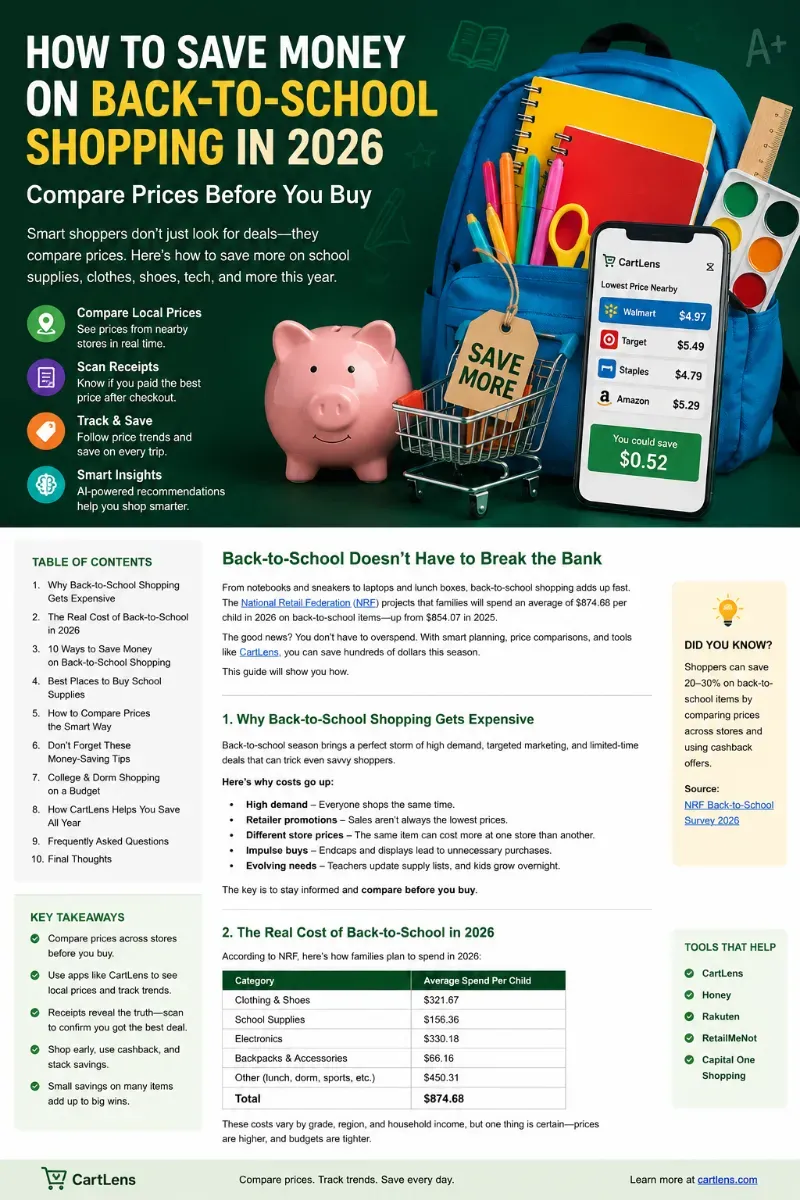
Back-to-school shopping can look like a simple checklist: notebooks, pencils, a backpack, clothes and maybe a new laptop. In reality, it has become one of the biggest seasonal spending events for American households.
The National Retail Federation reported that families with K-12 students plan to spend an average of $863.86 on back-to-school items in 2026, with total K-12 spending expected to reach $43.3 billion. College students and their families are expected to spend even more, averaging $1,437.79, with total back-to-college spending projected at $103.5 billion.
Those numbers make one thing clear: saving on back-to-school shopping is no longer about finding 25-cent notebooks. The larger opportunity is learning how to compare the entire shopping list across school supplies, clothing, shoes, electronics, dorm essentials and other recurring purchases.
This guide explains how to save money on back-to-school shopping in 2026 without turning the process into a second job.
Key Takeaways
Compare the full list across stores instead of chasing one advertised deal.
Prioritize required essentials and delay non-urgent purchases when the current price is weak.
Electronics deserve extra comparison because they are the largest planned K-12 spending category in 2026.
Store location, inventory and promotions can produce different prices for similar items.
A sale label is not proof that you found the lowest available price.
Receipts create a record of what you actually paid and can make later replenishment trips smarter.
Why Back-to-School Shopping Feels So Expensive in 2026
According to the National Retail Federation's 2026 back-to-school survey, K-12 shoppers plan to spend heavily across electronics, clothing, shoes and school supplies. The traditional classroom-supply aisle represents only part of the household bill.
The right response is not necessarily to buy everything at the cheapest-looking store. It is to create a system for deciding what to buy, where to buy it and when the price is actually good.
1. Start With the School's Actual List
The easiest way to waste money is to shop before you know what is required. Start with the official school or teacher list whenever possible. Then separate it into three groups: required now, likely needed later and optional.
2. Take Inventory Before You Buy Anything
Check last year's backpacks, unopened notebooks, binders, rulers, calculators, pencil cases, headphones, USB drives, lunch containers and art supplies. For college students, do the same with dorm items.
3. Set a Back-to-School Budget by Category
Split the budget across supplies, clothing, shoes and electronics. Saving $30 on a device can matter more than driving across town to save 20 cents on pencils. This is where understanding what a price tracker app does becomes useful.
4. Compare the Entire Shopping List, Not One Doorbuster
Retailers know that a dramatic deal can get you through the door. The better question is: What will my complete required basket cost at this store?
5. Understand Why Prices Can Differ Between Stores
Inventory, local demand, competition, regional operating costs, promotions and clearance decisions can influence store-level pricing. CartLens' guide to why prices differ between stores explains this in more detail.
6. Do Not Assume the Online Price Is the Store Price
Retailers can offer online-only promotions, pickup pricing, app deals, loyalty pricing, local clearance and store-specific markdowns. Our guide to online price tracking vs. physical shopping explains why digital and shelf-level prices can diverge.
7. Time Purchases Instead of Buying Everything in One Day
Buy required items when you find a strong price, track expensive non-urgent products instead of panic-buying, keep a replenishment list for items that can wait and recheck seasonal clearance after classes begin.
8. Be More Aggressive When Comparing Electronics
Compare the exact model number, condition, warranty, included accessories, student discount eligibility, return window and historical price when available. CartLens' guide on price tracker accuracy explains why data source, freshness and product matching matter.
9. Compare Unit Cost on Consumable Supplies
Unit pricing works for pencils, pens, markers, glue sticks, index cards, printer paper and other products sold in different quantities. The objective is the lowest useful cost, not maximum quantity.
10. Treat Brand Names as a Choice, Not a Default
Follow teacher requirements where specific products matter. For everything else, compare store brands and lower-cost alternatives.
11. Watch the Sale Label Carefully
A discount tells you a retailer reduced its own reference price. It does not prove another store is not cheaper.
12. Use Discount Stores Strategically
Discount stores can be useful for commodity products where brand and premium features matter less, but smaller package sizes can make the sticker price look attractive while producing a worse unit cost.
13. Separate Kid Influence From Required Spending
Define a baseline budget for required items and a smaller preference budget for upgraded designs, premium brands or trend-driven products.
14. Consider Secondhand for the Right Categories
Textbooks, calculators, dorm furniture, certain electronics, sports equipment and some clothing can be reasonable secondhand purchases.
15. Avoid Paying a Convenience Premium Without Realizing It
Last-minute shopping can destroy a careful budget. Build a small replenishment buffer for high-consumption basics so you can avoid emergency purchases.
16. Keep Every Back-to-School Receipt
The receipt records the transaction that actually happened. CartLens' guide to how receipt scanning works explains how receipt data can be converted into structured shopping information.
17. Audit Your Receipts After the Shopping Trip
Review the highest-cost items, products bought because of a promotion, unexpected purchases, items you may need again and products whose price differed from what you expected.
18. Use Price Tracking Differently for Different Products
School supplies benefit from local store and unit-price comparison. Electronics require exact-model comparison and often price history. Clothing and shoes require price, fit, durability and return-policy comparisons. Dorm essentials benefit from basket comparison and secondhand options.
If you are evaluating shopping tools, our guide on how to choose the right price tracker app explains why the best tool depends on how and where you shop. You can also read how price tracker apps work to understand where their price data comes from.
19. Build a Replenishment Strategy for the Rest of the School Year
Keep a short replenishment list and record the prices you paid initially. Instead of treating every replacement as a brand-new shopping problem, use your existing receipt data as a benchmark.
20. Let the Receipt Improve the Next Purchase
A traditional deal search asks, “What is cheap today?” A smarter system asks, “What did I buy, what did I pay, which items will I need again and what should I do differently next time?”
CartLens is designed around that second question. By turning real receipts into local price intelligence, shoppers can build a clearer picture of recurring purchases and potential overpayment over time.
Frequently Asked Questions
When should I start back-to-school shopping?
Start when you have a reliable school list and enough information to identify required items. Buying early can help spread costs, but buying too early without a confirmed list can create waste.
What is the best way to save money on school supplies?
Take inventory first, compare the full required basket across realistic stores, compare unit prices, avoid unnecessary brand upgrades and keep receipts so replenishment purchases can be compared later.
Should I buy all school supplies at one store?
Not necessarily. One store can be cheaper for basic supplies while another offers a stronger price on electronics or clothing. Compare the full basket and factor in time and travel cost before splitting the trip.
Are online back-to-school prices the same as in-store prices?
Not always. Retailers may offer online-only discounts, local markdowns, loyalty pricing, pickup pricing and store-specific promotions.
How can receipts help me save on school shopping?
Receipts show what you actually paid. Keeping or scanning them creates a personal price history that can help you evaluate later purchases.
Final Thoughts
The biggest mistake in back-to-school shopping is treating every sale as a savings opportunity. The real goal is to optimize the entire list.
Know what is required. Reuse what you already have. Put more comparison effort into expensive items. Compare pack sizes. Treat online and in-store prices as different signals. Keep your receipts. Learn from what you actually paid.
CartLens helps physical shoppers turn receipts into shopping intelligence so they can understand what they paid, compare local price signals and make smarter decisions on the next trip.
Etiqueta: back-to-school shopping, save money, price comparison, school supplies, clothing, shoes, electronics, shopping tips, price intelligence, 2026