
The Best AI Shopping Assistants in 2026
By Chris Nzouat · 2026-05-20 · Price Intelligence
Stop overpaying at checkout. Discover the best AI shopping assistants in 2026, from automated receipt scanners to conversational web co-pilots designed to defeat retail inflation.
Shopping used to be simple, but modern retail is an absolute minefield. Brands use dynamic pricing algorithms—a practice examined in NBER research on retail price dispersion—to alter shelf costs in real time, e-commerce stores deploy fake "limited-time" discount clocks, and "shrinkflation" quietly trims item volumes while keeping prices exactly the same.
If you are navigating the consumer market on your own, you are overpaying.
To defend your household budget, you need data-driven tools that work on your behalf. Artificial intelligence has fundamentally changed the consumer landscape, shifting power away from retail chains and back to everyday buyers.
Here is the definitive guide to the best AI shopping assistants in 2026 to completely automate your savings, verify real deals, and optimize your spending habits.
📌 Key Takeaways: AI Shopping Assistants at a Glance
Short on time? Here is the structural breakdown of the top AI platforms transforming consumer habits this year:
The Post-Purchase Auditor: Use advanced computer vision platforms to instantly extract itemized lines from receipts and cross-reference hyper-local market costs.
The E-Commerce Concierge: Deploy specialized browser extensions to monitor price stability, apply algorithmic coupons, and predict product price drops.
The Conversational Co-Pilot: Utilize conversational AI models to track down specific product metrics, summarize consumer reviews, and build optimized shopping lists.
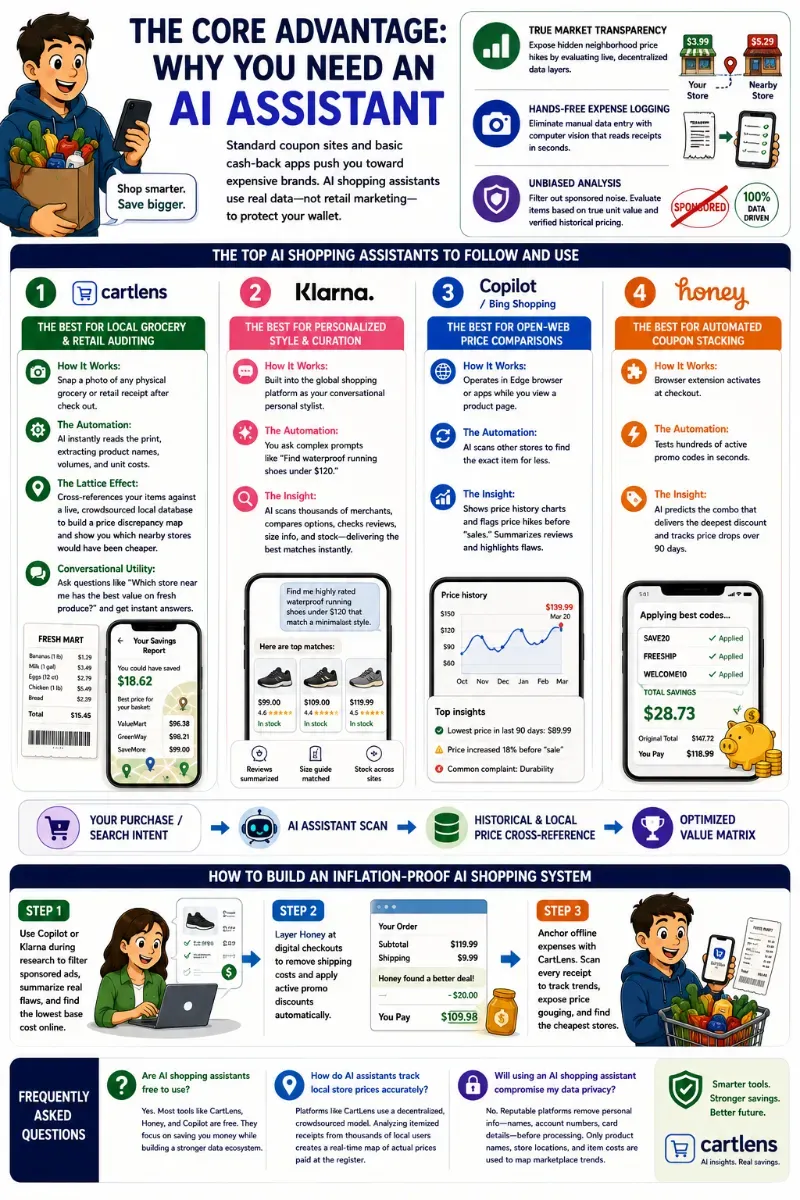
The Core Advantage: Why You Need an AI Assistant
Standard coupon websites and basic cash-back apps are no longer enough to stay ahead of retail inflation, a trend confirmed by Bureau of Labor Statistics CPI reports. Traditional programs are heavily subsidized by major corporations, which means they often push you toward expensive, highly processed name brands just to unlock a small rebate.
An AI shopping assistant functions differently. Understanding how AI is changing grocery shopping is key to maximizing savings, as it prioritizes data integrity over retail marketing, operating as an algorithmic advisor to provide:
True Market Transparency: Exposing hidden neighborhood price hikes by evaluating live, decentralized data layers.
Hands-Free Expense Logging: Eliminating manual data entry by utilizing receipt scanning tools to read receipts in seconds.
Unbiased Analysis: Filtering out sponsored affiliate noise to evaluate items strictly on their baseline unit value and verified historical pricing.
The Top AI Shopping Assistants to Follow and Use
1. CartLens: The Best for Local Grocery & Retail Auditing
CartLens is the anchor tool for managing brick-and-mortar variable costs. Instead of forcing you to search for items individually before visiting a store, CartLens handles your price optimization post-purchase using advanced AI computer vision.
How It Works: You take a quick photo of any physical grocery or retail receipt right after check out.
The Automation: The built-in AI instantly reads the print, extracting individual product names, precise packaging volumes, and exact unit costs.
The Lattice Effect: CartLens cross-references your itemized receipt against a live, crowdsourced geospatial database populated by real purchases from other shoppers in your specific zip code. It builds a localized price discrepancy map, telling you exactly which neighborhood storefront would have fulfilled your identical list for less money so you can adjust your next trip.
Conversational Utility: You can ask the integrated AI interface questions like, "Which store near me offers the absolute best value on fresh produce?" to instantly cut through marketing clutter.
2. Klarna AI Assistant: The Best for Personalized Style and Curation
For lifestyle shopping, fashion, and retail curation, Klarna's integrated AI ecosystem sets the standard for personalized digital commerce.
How It Works: Built directly into the global shopping platform, this assistant operates as a conversational personal stylist.
The Automation: You can text the assistant complex prompts such as, "Find me highly rated waterproof running shoes under $120 that match a minimalist style."
The Insight: The AI crawls thousands of online merchants simultaneously, comparing variations, evaluating sizing databases, summarizing thousands of customer reviews into a single paragraph, and showing you real-time stock availability across different sites.
3. Copilot / Bing Shopping: The Best for Open-Web Price Comparisons
Microsoft's integrated Copilot framework brings advanced web-crawling logic straight to your digital shopping cart, making it an essential tool for e-commerce buyers.
How It Works: Operating within the Edge browser or mobile applications, it actively reads the web page of the product you are currently viewing.
The Automation: The AI automatically scans alternative online storefronts to see if the exact same item is available elsewhere for less.
The Insight: It provides a comprehensive price history chart directly on the screen, letting you know if the seller quietly marked up the product's price right before launching a "sale." It also summarizes text-heavy product reviews, highlighting common user complaints or product manufacturing defects before you click buy.
4. Honey (AI-Enhanced Extensions): The Best for Automated Coupon Stacking
PayPal's Honey has integrated machine learning layers to transform how promotional codes are verified and applied across millions of e-commerce checkout lanes.
How It Works: The extension sits quietly in your desktop or mobile browser until you arrive at a digital payment window.
The Automation: Rather than forcing you to test dozens of expired codes manually, Honey's algorithm tests hundreds of active combinations in a matter of seconds.
The Insight: The updated system uses predictive AI to determine which code sequence yields the absolute deepest discount based on your specific cart composition, tracking price drops across your favorite items dynamically over a 90-day window.
How to Build an Inflation-Proof AI Shopping System
To get the most value out of artificial intelligence, do not rely on just one single tool. Treat your household budget like a financial system by layering these automated assistants together:
Step 1: Use Copilot or Klarna during your research phase to filter out sponsored retail ads, summarize real product flaws, and identify the lowest base cost online.
Step 2: Layer Honey at digital checkouts to strip out unnecessary shipping costs and apply active promotional discounts automatically.
Step 3: Anchor your offline expenses with CartLens. Scan every physical paper receipt you get from grocery stores, pharmacies, and supermarkets to continuously track spending trends, expose neighborhood price gouging, and map out the absolute cheapest storefronts in your local area with the price tracking app.
Frequently Asked Questions (FAQ)
Are AI shopping assistants free to use?
Most consumer-focused AI shopping tools like CartLens, Honey, and Copilot are completely free to download and use. They focus on saving you money to build a stronger data ecosystem for their underlying software infrastructure.
How do AI assistants track local store prices accurately?
Platforms like CartLens use a decentralized, crowdsourced model. By analyzing itemized receipt text uploaded anonymously by thousands of local users right after checkout, the AI builds a real-time price map that tracks actual prices paid at the register, completely bypassing inaccurate store websites. This crowdsourced approach is the reason why supermarkets have different prices for the same items even in the same city.
Will using an AI shopping assistant compromise my data privacy?
Reputable financial technology platforms prioritize user privacy. During the scanning process, advanced systems scrub away all personal markers—such as your full name, credit card details, bank digits, and account serial numbers. The software strictly aggregates product names, store locations, and item costs to map marketplace trends cleanly and safely.