
The Scan-First Mindset: How People Who Never Overpay Think Differently
By Chris Nzouat · 2026-05-10 · Shopping
Unlock the 'scan-first mindset' to save money effortlessly. CartLens offers instant price comparison & receipt audits for smarter shopping in physical stores. Stop overpaying!
Think about the last time you bought something online. Before you clicked purchase, you probably checked a few things: reviews, whether the price was reasonable, maybe a quick competitor search. You had data. The decision felt informed.
Now think about the last time you bought something in a physical store. You saw a price. You paid it. You left.
The information standard for physical retail has always been lower than for online retail — not because physical purchases matter less, but because the tools to match that standard haven't existed. Until now, there was no way to check a price tag at a pharmacy or scan a receipt at the register and immediately know whether you paid a fair price.
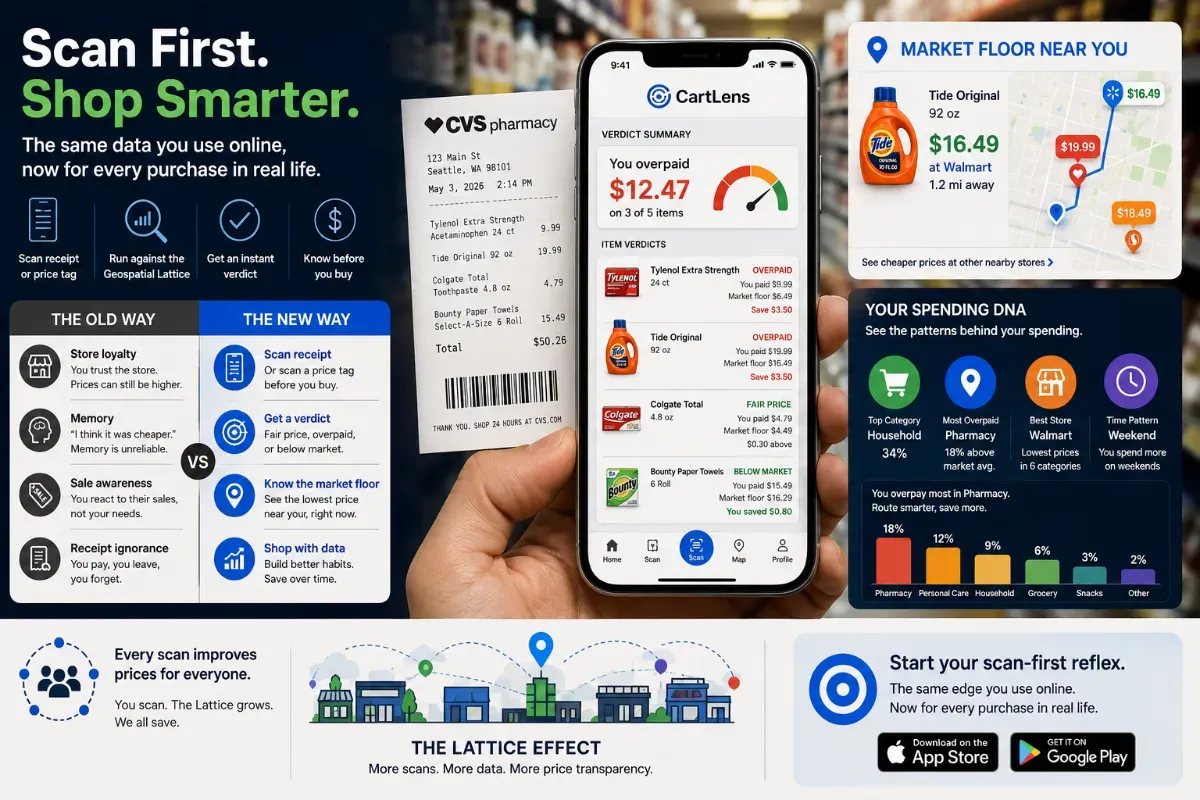
That's changing. And the people who've made the shift describe it as a reflex — the same kind of reflex you already have online.
The Old Way Versus the New Way
The old way of managing your shopping spend relies on a set of heuristics that feel reliable but aren't:
Store loyalty. You shop at the same places because you trust them. The problem is that trust doesn't compress prices. A store you trust can still charge you more than competitors, and your loyalty removes the competitive pressure that would incentivize them to do otherwise.
Memory. "I think this was cheaper last week." With prices constantly changing, as detailed in the latest Bureau of Labor Statistics CPI reports, memory-based price comparison is notoriously inaccurate, especially for the dozens of small purchases that make up the bulk of most people's retail spending.
Sale awareness. Watching for sales is a reactive strategy. You optimize around the store's promotional calendar, not around your actual needs. Sales also frequently apply to prices that were quietly inflated before the promotion.
Receipt ignorance. Most receipts are glanced at, stuffed in a pocket, and forgotten. They contain more useful information than almost any other document in your daily life, and understanding how receipt scanning works reveals the value hidden in these paper slips.
The new way is simpler. You scan the receipt. You get a verdict. You know.
What Scanning a Receipt Actually Tells You
When you scan a receipt with CartLens, you're not just recording what you spent. You're running every line item against the Geospatial Lattice — a crowdsourced price index built from real receipts from real shoppers near you.
The system tells you, for each item:
Whether the price you paid is at, below, or above the local market floor
What the market floor for that item actually is, right now, in your area
Which nearby stores are currently selling the same item for less, if any
This happens in seconds. The receipt you just got from the cashier becomes a diagnostic document — a line-by-line audit of where you stand against the market.
The same scan works for a price tag you're looking at before you buy. You can scan a price in the store, see the verdict before you commit to the purchase, and decide whether you want to look elsewhere.
This is the scan-first reflex. It's the same thing you already do online, adapted for physical retail.
Why the Reflex Matters More Than the Individual Save
It's easy to frame price-checking as a budgeting behavior — something you do when money is tight. But the people who use CartLens consistently describe it differently. They're not budgeting. They're calibrating.
The point isn't to save $2 on a specific item on a specific day. The point is to build an accurate mental model of what things cost near you. Over time, that model changes how you shop without requiring conscious effort for every purchase.
When you've scanned enough receipts, you start to know — in your gut, before you even open the app — which stores in your area are price-competitive in which categories. This intuitive routing is based on a deep, data-driven understanding of why prices differ between stores in your specific neighborhood. You stop defaulting to the pharmacy next to your office for everything and start routing intelligently: household items here, personal care there, electronics somewhere else. This isn't just anecdotal; NBER research on retail price dispersion confirms that significant price differences exist for identical products in the same local market.
The scan-first reflex doesn't just save money in individual transactions. It restructures your shopping patterns toward the stores that actually offer value in the categories where you spend the most.
The Spending DNA Effect
As the leading app to understand spending habits, CartLens builds what it calls your Spending DNA after enough scans — a view of your aggregate purchase behavior across stores, categories, time periods, and price performance.
Spending DNA makes patterns visible that are invisible inside any single transaction. You might discover that one category of spending is consistently above the market floor — not because of any single bad purchase, but because of a habitual store choice. Or you might discover that a store you'd written off as expensive is actually price-competitive in the categories where you spend the most.
This is the difference between transaction-level thinking and pattern-level thinking. Most people manage their spending transaction by transaction, which means they can't see the patterns. Spending DNA makes the patterns visible.
Becoming a Lattice Architect
There's a second-order benefit to the scan-first mindset that most people discover gradually: the more you scan, the better the Lattice becomes for everyone in your area.
Every scan you contribute is a data point that improves the price index for your neighborhood. If you're one of the first people scanning at a particular store in your city, you're building the reference layer that lets others know whether they're being charged fairly there. The network effect is real: as more people scan, prices become more transparent, and the information advantage retailers have enjoyed over consumers starts to close.
This is the Lattice Architect dynamic — scanning as a contribution to a shared price transparency layer, not just as a personal optimization tool.
How to Start
The shift to scan-first doesn't require a habit overhaul. It requires one change: after your next purchase, scan the receipt with the best app to track prices for physical retail. Not to save money on that specific transaction — it's already done. To start building your local price model.
After a few scans, the Lattice has enough data about your area and your purchase patterns to start giving you verdicts that are immediately actionable. That's when the reflex kicks in. That's when checking a price before you commit feels as natural as checking a review before you buy online.
The information asymmetry that retailers have built their margins on isn't inevitable. It's just a gap — a gap between what they know and what you know. Scanning closes the gap.
Frequently Asked Questions
What does CartLens do when I scan a receipt? CartLens extracts every line item from your receipt using AI-powered optical recognition and runs each one against the Geospatial Lattice — a crowdsourced price index built from real physical receipts near you. The result is a verdict for each item: fair price, overpaid, or below market, along with which nearby stores are cheaper if applicable.
Can I scan a price tag before I buy, not just after? Yes. CartLens works on price tags as well as receipts. You can scan a price in the store before you commit to the purchase and get an instant verdict against the Lattice.
What stores and categories does CartLens work for? CartLens works for any physical store in any category — grocery, pharmacy, electronics, hardware, apparel, and more. It's not a grocery app. It's a price intelligence layer for all physical retail.
What is Spending DNA? Spending DNA is your aggregate purchase history across CartLens — a view of your shopping patterns, store choices, category spending, and price performance over time. It reveals structural patterns that aren't visible when you're looking at individual transactions.
Does scanning my receipts contribute to the price index? Yes, if you opt in. Scans you contribute are added as anonymous, GPS-verified data points to the Geospatial Lattice, improving price accuracy for everyone in your area. You can opt out at any time, and your contribution is always anonymous.
وسم: scan-first mindset, save money, price comparison, receipt audits, smarter shopping, never overpay, physical stores, retail, shopping tips, CartLens