
Understanding Price Discrepancies: Why Supermarkets Have Different Prices for the Same Items
By Chris Nzouat · 2026-05-19 · Shopping
Why do nearby grocery stores charge vastly different amounts for the exact same products? Discover the secrets behind retail price discrepancies and how to use AI to find the lowest local prices.
Have you ever bought a brand-name coffee at your neighborhood grocery store, only to find it costs $3 less at a competing supermarket just two miles down the road? This common occurrence is a prime example of a price discrepancy.
In retail, the difference in prices for identical goods across different stores is rarely accidental. Retail chains use sophisticated algorithms to maximize profits based on your location and shopping habits.
If you want to protect your wallet, understanding why these local price variations exist is the first step toward beating the system. Here is the data-driven breakdown of price discrepancies and how you can exploit them to slash your weekly bills.
📌 Key Takeaways: Price Discrepancies at a Glance
Short on time? Here is why identical products have different prices at local stores:
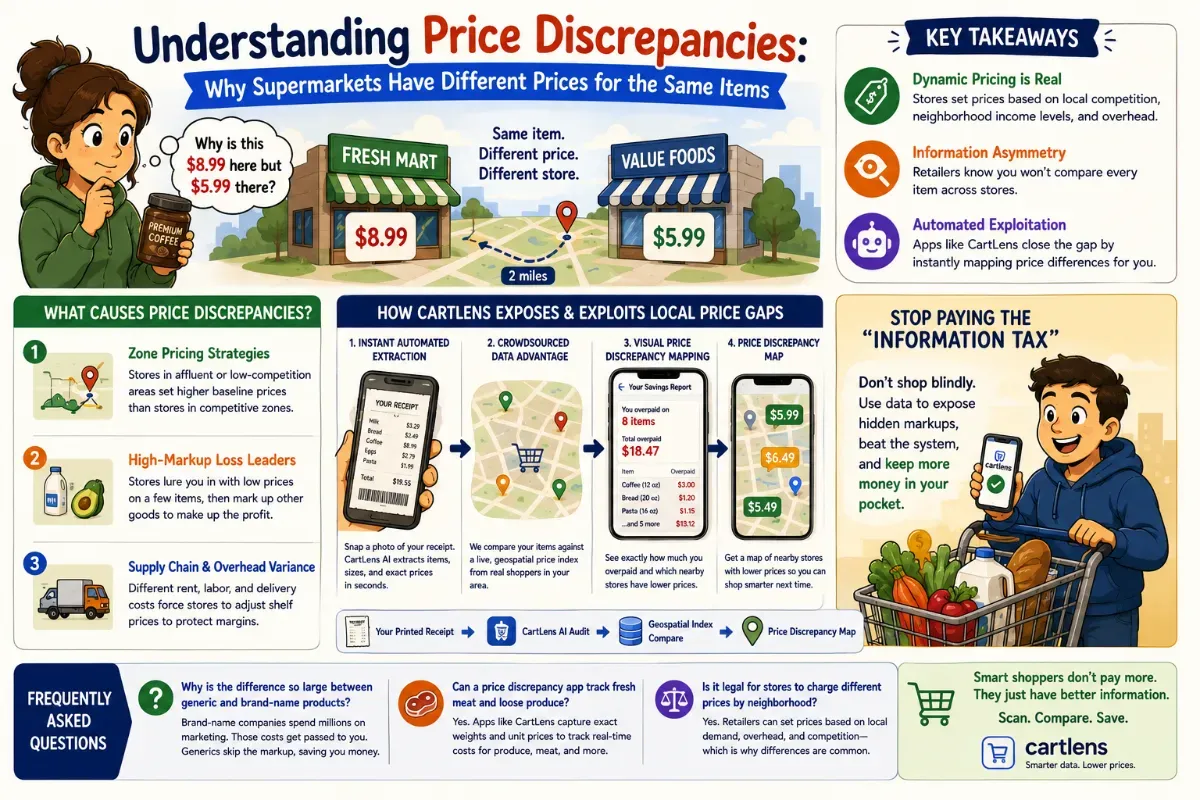
Dynamic Pricing is Real: Grocery stores change shelf prices constantly based on local competition, neighborhood income levels, and delivery overhead.
Information Asymmetry: Retailers count on the fact that you do not have the time to drive around and compare item-level costs manually.
Automated Exploitation: A grocery app like CartLens bridges this information gap by instantly scanning your receipts and mapping regional price differences for you.
What Causes Price Discrepancies in Retail?
A price discrepancy occurs when the exact same product (same brand, size, and barcode) is sold at different retail values by separate merchants. While you might expect pricing to remain stable across a single city, several factors drive the difference in prices, a phenomenon confirmed by NBER research on retail price dispersion.
1. Zone Pricing Strategies
Large supermarket chains map cities into distinct geographic zones. A store located in an affluent neighborhood with zero direct competitors will feature higher baseline shelf prices than a store from the exact same chain located in a highly competitive retail corridor. This is a primary example of why prices vary by location.
2. High-Markup Loss Leaders
Supermarkets often discount a highly visible item—like milk or avocados—below cost to lure you into the building. These are called "loss leaders." To make up for the lost profit, the store quietly inflates the prices of surrounding goods like bread, spices, or condiments, creating massive price gaps compared to rival grocers.
3. Supply Chain and Overhead Variance
Even stores within walking distance of each other can face wildly different operating costs. Variations in commercial real estate rent, local union labor rates, and distributor delivery routes force individual store managers to adjust their localized shelf tags to preserve profit margins, an issue detailed in the recent FTC Grocery Supply Chain Report.
How CartLens Exposes and Exploits Local Price Gaps
Supermarkets count on your "price blindness." They know that while you might remember the cost of a gallon of milk, you cannot memorize the exact price of every item in your pantry. This is where CartLens completely shifts the balance of power back to the consumer.
Instead of requiring you to browse through endless weekly circulars or walk through storefronts with a notebook, CartLens uses advanced AI to track localized price discrepancies automatically:
Instant Automated Extraction
When you take a photo of your paper receipt right after checkout, the CartLens AI engine extracts the itemized product names, packaging volumes, and exact purchase costs. It turns a messy piece of paper into structured financial data in seconds, demonstrating how receipt scanning works to empower shoppers.
The Crowdsourced Data Advantage
Once your receipt is digitized, CartLens cross-references your itemized costs against a live, geospatial price index populated by real purchases from other shoppers in your zip code. This powerful feature is what is a crowdsourced price index in action.
Visual Price Discrepancy Mapping
The app compiles the difference in prices and generates a personalized savings report. If a competing supermarket down the street has lower baseline prices for the majority of the items you just bought, CartLens highlights the exact financial gap. It shows you precisely how much money you lost to a localized price markup and redirects your next shopping trip to the highest-value local storefront.
Stop Paying the "Information Tax"
Retail price variations are essentially a tax on the unoptimized. When you shop blindly, you pay a premium simply because you lack marketplace visibility. By leveraging a dedicated receipt auditor and the best price tracker app like CartLens, you can see past gimmicky sales, expose hidden neighborhood markups, and keep your hard-earned cash in your bank account.
Frequently Asked Questions (FAQ)
Why is the difference in prices so large between generic and brand-name products?
Name-brand manufacturers spend millions of dollars on national advertising and premium shelf placements. Supermarkets pass those costs directly to you. Store generics often feature identical ingredients but skip the marketing markup, leading to steep price discrepancies.
Can a price discrepancy app track fresh meat and loose produce?
Yes. Advanced crowdsourced apps like CartLens process exact weight metrics and unit rates from user receipts. This allows the system to accurately track and map real-time cost variations for fresh vegetables, fruits, and meats across neighboring stores.
Is it legal for stores to charge different prices based on neighborhood locations?
Absolutely. Retailers are legally permitted to set shelf prices according to localized market demand, operating overhead, and competitive density, which is why regional price disparities are so common.
タグ: price discrepancies, supermarket prices, grocery prices, retail pricing, dynamic pricing, CartLens, AI shopping, local deals, cost saving, shopping tips